Showing posts with label Canadian Rockies. Show all posts

Sunday, August 24, 2025

One-off cards I’ve painted recently

Cascade Ponds at Banff

watercolour card

©2025 Charlene Brown


Spirit bear mother and cubs

watercolour card

©2025 Charlene Brown

Lakes above O’Hara

watercolour card 5” x 7”

©2025 Charlene Brown

Fall flowers in the Valley of the 10 Peaks

watercolour card 5" x 7"

©2025 Charlene Brown


As I mentioned in a blog post in May of last year, I have a large supply specially-cut pieces of heavy watercolour paper which can be folded into 5”x7” cards.  

So, occasionally I paint greeting cards and sometimes I get prints of these cards made.  But I prefer having cards made from larger paintings, which allows for more detail to be included.

Above are four examples of unique cards of which I won’t be getting prints made.  Only one person will get each of these.  


Sunday, August 17, 2025

Painting an Entire Canyon with telescoped perspective


Johnston Canyon, Banff National Park
crayon, watercolour, and ink
©2025 Charlene Brown

Recently, I tried an experiment using a Google map of a canyon about 20 km west of Banff, as well as several Google Streetviews* along the canyon.  Each waterfall is placed with some accuracy but, as you might suspect, is much larger than it should be in a picture this size.

Originally, I considered including the Ink Pots, located about 3 km above Johnston Canyon, in the painting but soon realized that would be ridiculous.  I painted the Ink Pots in 2018

·      * Yes, Johnston Canyon has in fact been streetviewed and many of the waterfalls have also been photographed using a Google 360 degree camera. The photograph on the right, by Greg Belluomini, with the location just near the Upper Falls indicated in the square insert in the lower left corner, was one of my reference photographs.  You may recognize it in the painting above, about one third of the way down from the top of the picture.  Or you may not – I barely recognized it myself. 


Sunday, August 10, 2025

When we weren’t allowed to go to Alberta


Victoria Glacier from Mt. Fairview
watercolour and crayon
©2025 Charlene Brown

I’ve been thinking lately of that awful time in the first stages of the pandemic before any vaccines were developed and interprovincial travel was discouraged. My obligatory Alberta Rockies paintings at that time were often based on pictures sent to me by our Calgary daughter.  She and her family, like many Albertans, found themselves exploring parts of their province even they had not been to before.

I put a small semi-abstract sketch of Victoria Glacier from Mt. Fairview in my 9 September 2020 blogpost using for reference a picture our daughter had taken of her daughter in July of that year.  After I finished the painting above, re-using that picture as one of my references, it occurred to me I should have tried including our granddaughter….  It was too late to paint her so I Photoshopped her in.  I’m not sure what she was pointing at in the original photo, but the way she was placed in my painting has her pointing at the Plain of Six Glaciers, a small green plateau which can be seen just below the right hand end of Victoria Glacier.

Sunday, July 6, 2025

Alberta ̶ where I lived first and where I still say I'm from

Banff
watercolour and crayon
©2023 Charlene Brown

I was born in Banff, lived there until I finished high school, and returned to work there each summer until I finished university.

This is the only one of my Alberta paintings in which the place looks almost exactly the same as when I lived there.


Edmonton
watercolour and crayon
©2016 Charlene Brown

I lived in Edmonton from 1959 to 1962, my first three years at the University of Alberta.  However, the city pictured here was not there at the time. The only structures in this painting that I remember from my university days are the Provincial Legislature on the far left and the Fairmont MacDonald Hotel, which is just about exactly in the middle – and it is quite different from the MacDonald I remember. Back then, the hotel had a huge ‘Brutalist’ addition, and the whole structure was referred to as a ‘tiny perfect chateau and the box it came in.’ Anyway, the box has been removed, and dozens of much nicer boxes have been added to form today’s Edmonton skyline.

Calgary
watercolour, crayon and marker
©2012 Charlene Brown         

My final year at University of Alberta was completed at the Calgary campus, UAC, which became the University of Calgary a few years later. 

This painting of Calgary was based on photos I took from a 2012 WestJet flight to Calgary and most of the buildings in it– bank towers, Calgary Tower, Suncor (the fact the building is red is only part of the reason it was initially referred to as Red Square), the Bow Building, Olympic Park ski jump, and the Alberta Children’s Hospital  ̶  were not there when I was at university.     


Sunday, March 9, 2025

Thermovoltaic systems


Lafarge Exshaw - the largest cement plant in Canada
watercolour and coloured pencil
©2025 Charlene Brown

Thermovoltaics is a technology that converts heat into electricity. Waste heat is everywhere. Globally, of the energy used to power the industries that the world needs such as cement and steel, approximately 60% is simply lost as waste heat. 

Industrial activities account for about one third of total energy consumption and urgently need to cut CO2 emissions.

In 2022, the energy intensity of the cement sector reached 100 kWh per tonne, with fossil fuels as the primary source of thermal energy. Globally, iron and steel manufacturing consumes 8% of total energy demand, contributing to 2.6 billion tonnes (gigatonnes) of CO2 emissions annually. 

Addressing the emissions from these industries and finding ways to capture and productively use the vast amounts of industrial waste heat are critical steps in the fight against climate change.


Sunday, January 5, 2025

The Plan for 1150 Words in 2025


Front cover: Visualization of the Anthropocene
                        Crowfoot Glacier, Canadian Rockies (1910, 1960, 2010)
watercolour, Photoshop™ and InDesign™
©2023 Charlene Brown


  1. Visualization of the Anthropocene: I will complete this series of essays and illustrations of the increasingly drastic climate effects of the Anthropocene, with emphasis on Arctic warming. 
  2. Travel painting: I have two painting trips planned, one to an artist colony, and the other to see my great-grandchildren.  Neither will include the Seattle airport.
  3. Publish Time Travel with a bag of Crayons
  4. Decluttering computer and hardcopy files.  And art supplies.

  5. AI Training – learning more about the AI capabilities on my computer, as well as training that AI to understand my way of thinking in order to refine my ideas and, possibly, my paintings.  (Apparently this can be done!)

Sunday, December 15, 2024

More painted Christmas cards

Banff Avenue
watercolour Christmas card
©2024 Charlene Brown

Banff Avenue
watercolour Christmas card
©2024 Charlene Brown


I painted another realistic(ish)/abstract(ish) pair of cards, this time the view of Banff Ave. from the bridge over the Bow River, and mailed the second one to the only person I knew would prefer it to the first.


Sunday, December 8, 2024

Ready for Christmas

Consolation Lake
watercolour Christmas card
©2024 Charlene Brown

Three Sisters
watercolour Christmas card
©2024 Charlene Brown

I started painting Christmas cards in September because I had travel plans for October and November  (which I have since blogged about) and knew I wouldn’t have a lot of time available before Christmas.  So, at the time, I was pretty impressed with my Christmas readiness. 

Now, not so much, because I have done very little else to get ready. This is partly due to the travel interruption I wrote about in blog posts on October 9 and  October 16 (and have also written about in a couple of time-consuming travel insurance claims.)


Sunday, November 24, 2024

The realism/abstract continuum


All of these pictures, except for the one on the left, exist only on my computer.  They are Photoshop™ variations of this original card painting of Mount Rundle.  

I could, of course, print them on some of my still-huge collection of blank watercolour cards ─ if I had a printer that would put up with that sort of thing.  But my sometimes-temperamental printer has been working beautifully with regular paper recently, and I don’t want to antagonize the thing.

So all but this one will continue to exist only on my computer.


Sunday, November 17, 2024

One last painted pair – for now

Mount Rundle
watercolour card
©2024 Charlene Brown

This is the mountain as seen from the old highway just west of Banff – a location frequently used by the plein air classes when I attended the Banff School of Fine Arts 70 years ago.

Semi-abstract version

This is the last painted pair in this series.  Next I’m going to try computerpainting (with Photoshop™) variations along the realism/abstract continuum ─ on one painting.

There will be more pairs where both are painted, as I’ve still got lots of those blank watercolour cards.


Sunday, November 10, 2024

Still chipping away at my 50-pack of greeting cards…

Castle Mountain
watercolour card
©2024 Charlene Brown

This is the view of Castle Mountain seen from the TransCanada Highway about halfway between Banff and Lake Louise. This card was a variation on one of the few acceptable Christmas cards I painted last year.

Semi-abstract version

I prefer this to the representational version above, but hardly anyone else does.


Sunday, November 3, 2024

Another pair of greeting cards

Lake Minnewanka and Mt. Inglismaldie
watercolour card
©2024 Charlene Brown

This version of Lake Minnewanka was on a Thank you card I painted several months ago.

Semi-abstract version

This card was painted using a technique I outlined in a 2018 blog post about abstracting landscapes I’d paintedpreviously.  (When painting the much smaller greeting card however, the initial rough drawing is done with masking fluid, rather than oil pastel or crayon.) As in the 2018 abstract, I’ve introduced the Hundertwasser’ effect on the deciduous trees.


Sunday, October 27, 2024

More greeting card paradigm shifts

Camping at Two Jack Lake
watercolour and ink on a greeting card
©2024 Charlene Brown

Semi-Abstract version


In a blog post on June 16,  I mentioned that I have tried to see and paint things differently, shifting away from realism toward abstraction.  I also said that “sometime soon” I would try painting pairs of greeting cards of the same location, one representational and one semi-abstract (but recognizable), at the same time.

Since then I finished and wrote about the paintings I started on a cruise to Alaska and later re-wrote a series of blog posts on the pschology of creativity.  It turns out that now is the soonest I could manage to start writing about my planned paradigm shift.

I sent the first ‘Camping at Two Jack Lake, above, to one of my granddaughters for her birthday.  She has actually been to this campground near Banff many times. The other went to my sister, who is an artist who prefers to work abstractly herself and is just about the only person I know who prefers my less representational paintings.


Sunday, June 16, 2024

Paradigm shift on a greeting card


The Million Dollar View
Watercolour greeting card
©2024 Charlene Brown

For years I have tried to see and paint things differently, shifting away from realism toward abstraction.  Often the painting fights back, and I find myself adding picky details to what should have been the finished product.

I realized that’s what had happened here when I compared previous versions I had painted of roughly the same view.

This much-photographed scene was named ‘The Million Dollar View’ about a hundred years ago by the marketing department of the Canadian Pacific Railway, as it was the view from the (then CPR-owned) Banff Springs Hotel.  Sometimes pictures of the Million Dollar View included the hotel itself, as in the painting below one of the (slightly) more abstract ones I referred to above.  

Banff Springs, 2014
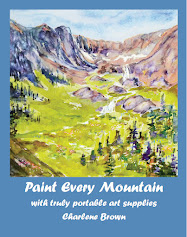
from the ’50 Shades of Orange’ chapter in Paint Every Mountain

Some time soon I am going to try painting pairs of greeting cards, one representational and one more abstract, at the same time.  Using the same colours. Maybe.

Sunday, June 9, 2024

This is not a waterfall


Bow Falls
watercolour greeting card
©2024 Charlene Brown


I was surprised when I looked for previous paintings of the (inaccurately named) Bow Falls that I might have written about on this blog, to find that there were none unless you consider the painting below, based on an aerial view of the Bow Valley. It includes the Bow Falls, among many other things.


This particular painting reminded me of the fact that this stretch of the Bow River consists of Class 5 rapids, not falls, stretching back toward the town of Banff almost half a kilometre.


Bow Valley
Watercolour
©1991 Charlene Brown

Sunday, June 2, 2024

Another ‘Street View’ greeting card


Climbing to Victoria Glacier
watercolour greeting card
©2024 Charlene Brown

Here’s another view that didn’t quite fit into the multi-viewpoint painting of the Plain of Six Glaciers  I mentioned last week.  On the extreme left of Climbing to Victoria Glacier, as well as the painting I wrote about last week, the ‘claws’ at the north end of Mt. Lefroy can be seen.

I must admit, even after hiking up to the glaciers a few times and seeing Mt. Lefroy from various angles, I hadn’t noticed this formation until my attention was drawn to it by the $1,667,500. sale of a Lawren Harris sketch that I wrote about in 2014. 

Sunday, May 26, 2024

My plan to produce a few more hand painted greeting cards


 Abbott’s Pass
watercolour greeting card
©2024 Charlene Brown

My semi-successful project to paint Christmas cards last year ─ only six turned out, and another was Photoshopped into an acceptable jpeg suitable for getting prints made  ̶   used up my supply of blank watercolour cards.

I decided to buy another six-pack and try painting Other Occasion, Congratulations, Get Well or whatever-came-along cards. Turns out they don’t sell six-packs or even ten-packs anymore.  I had to buy a set of 50!

The painting I used on my April 7 blogpost was the first painted card from this enormous supply, and is actually quite a bit smaller than it appears on the screen.

The greeting card painting above, Abbott’s Pass, shows one of the many individual Google Street Views I painted prior to combining several (not including this one) into a  multi-viewpoint picture of the Plain of Six Glaciers.  I’ll write about another one that didn’t ‘make the cut’ next week.

Sunday, May 5, 2024

Google Street View − the ultimate multi-viewpoint presentation!

Plain of Six Glaciers above Lake Louise
Watercolour, crayon and computer
©2024 Charlene Brown

In the late 1950s when I was in high school, it was our custom to hike to the Plain of Six Glaciers after work on the August long weekend – a distance of about 5 km with an elevation gain of about 500 m. After camping overnight on the Plain of Six Glaciers, we would continue up a much steeper, more rugged trail along the crest of a moraine to a ‘corn snow’ slope at the north end of Victoria Glacier. Carrying our ski equipment! 

Most of us had only enough stamina for one or two careful runs down the slope, stopping well short of the precipitous drop-off for which Mt. Victoria is famous.  The (barely) skiable part of the glacier is on the right edge of the painting above.   

To my amazement, I recently discovered that the trail can be found on Google Street View – I can’t believe somebody got a Google camera up there!

Have a look at this link or this one  Swivel the camera at each location and you’ll see a few of the many shots I used to produce the telescoped and manipulated composition above.


Sunday, April 28, 2024

More viewpoints are more fun

Middle Spring on Sulphur Mountain
watercolour and ink
©1992 Charlene Brown

A month ago I used a recent painting of the Middle Spring to illustrate a blog post about a hypothetical self-sustaining CO2 removal loop

The painting on the left, of the same location, was done back in the day when I used to limit myself to one viewpoint.  I prefer the 2024 version -- and paintings with more content, in general.

These additional viewpoints can be achieved by rotating your field of vision or moving to a slightly different vantage point. Or both.

In my latest book, Paint Every Mountain,  I devote a whole chapter to ‘Moving Around, Combining and Superimposing for a Better Composition’ and next week I'll write about the ultimate multi-viewpoint presentation.


Sunday, April 7, 2024

Solving two Anthropocene problems with a self-sustaining loop


The cave and outflow from the Middle Springs
watercolour and crayon
©2024 Charlene Brown

Another proposed combination of technologies may result in a synergistic cost saving by creating a self-sustaining loop.  CO2 removed from the atmosphere by Direct Air Capture (DAC) is stored in deep, hot aquifers.  Heat brought to the surface could then be used to power the DAC process.  Thus the excess CO2  itself could reduce the high cost of removing it from the atmosphere. 

Like the nearby geothermal source I wrote about eight years ago, however, this particular hot spring would not be a suitable location for such a self-sustaining loop.