Sunday, February 27, 2022

Time-traveling with a bag of crayons again – and a cautionary tale


Sacsayhuaman, Peru
Watercolour and crayon
©2022 Charlene Brown

My first attempt to paint this Incan ruin on a mountainside above Cusco is shown below.
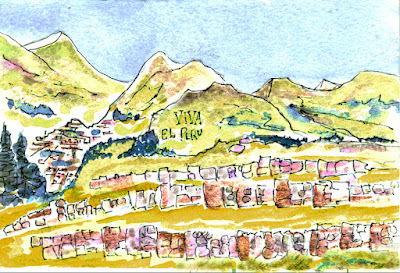

The words ‘Viva El Peru’ on the far side of the valley are actually lighter than their surroundings and started out written in a white crayon resist, but the resist lost its grip, and I decided to use ink instead.  But I would have preferred to get the right (white) effect with the crayon – Hence the cautionary tale…

Be careful where you find your white crayons

I was having lunch in a restaurant with my daughter and her kids in 2009 just before I took one of them to Peru, and the kids were given white placemats and crayons to play with.  I noticed there were a lot of white crayons (normally kind of hard to come by as you have to buy a large pack to get one white crayon).  My daughter pointed out that the restaurant had lots because, obviously, ”What kid is going to want to draw on white paper with a white crayon?”

I asked if I could have a couple, and the answer was, “Sure – what kid is going to want to draw on white paper with a white crayon?” So we took a couple of them all the way to Peru -- where they proved to be completely useless at resisting anything because, again obviously, the crayons kids are given in restaurants are washable.

This painting's 'Viva El Peru' was done with totally unwashable crayons.


Sunday, February 20, 2022

Twentieth Century Design in Europe


The Atomium, Belgium
Watercolour, crayon, and marker
Charlene Brown

The Atomium was constructed for the first post-war world exhibition (Expo 58). The nine sphere model of atomic structure represents faith in the power of science, and in nuclear power.

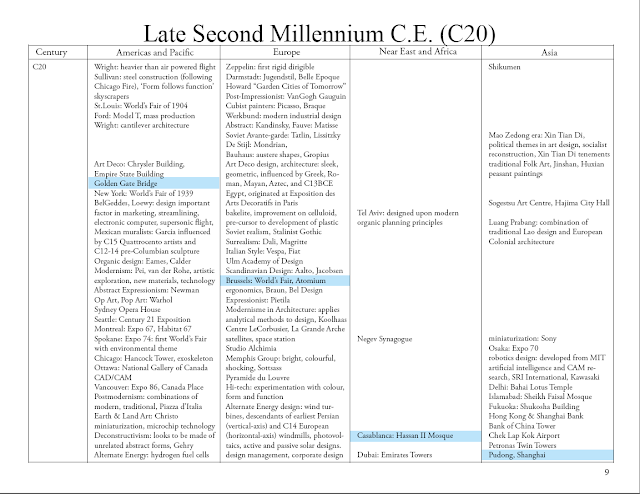
This is the last of the four samples highlighted in the twentieth century time capsule below.


I have written nine stories for the online publication platform, Medium,
 each with four paintings representing four areas of the world.  So far, seven of these stories have been published, all with the underlying message: 
“History isn’t just a series of wars, you know.”  

A few of these examples, like today’s painting, mention war or even have obvious military connections – Citadel in Mohenjo-Daro, Great Wall of China, Fort at Bahla, Alhambra at Grenada, and Morrow Castle in Havana.  But I think there is general agreement with my point that the art and architecture of civilization often outlasts the re-drawn maps and treaties and military alliances and other results of wars... And will continue to do so.

Sunday, February 13, 2022

Twentieth Century Design in the Near East and Africa


Hassan II Mosque, Casablanca, Morocco
Watercolour and crayon
Charlene Brown

Hassan II was the King of Morocco from 1961 until his death in 1999.  Because he stated in 1980 that he wanted the Hassan II Mosque to be built on the water, it is situated on the edge of the Atlantic Ocean.  Work began in 1986 and the mosque, with the tallest minaret in the world, was completed in 1993. It can accommodate 25,000 inside and an additional 80,000 in the outdoor courtyards.

Next week I will post my fourth painting illustrating twentieth century design selected from the cross-cultural timeline I printed in a blog post a couple of weeks ago. 

Sunday, February 6, 2022

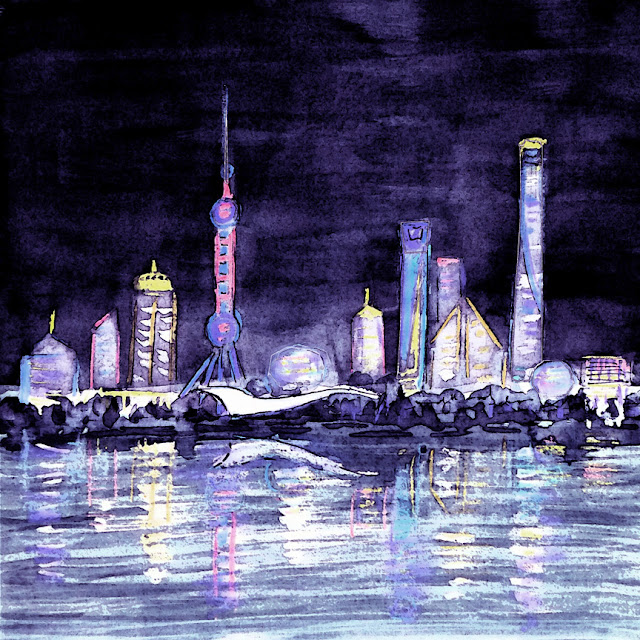
Twentieth Century Design in Asia


Pudong, Shanghai
Watercolour, crayon and marker
©2022 Charlene Brown

In the early twentieth century, the Bund, with dozens of foreign banks and magnificent commercial buildings in the Beaux Arts Style, was world famous, the best known area of Shangai. However, The Communist government that took over in 1949 began the systematic removal of these ‘colonialist’ structures and, although there was some restoration in the 1970s and ’80s, international interest soon shifted to the Pudong New Area, directly across the river, when its amazing redevelopment began in the late twentieth century.  Some of the buildings shown here were not completed until the twenty-first century, but the structure most often associated with Pudong – the iconic Oriental Pearl TV Tower (with red and blue lighting in the painting), was completed in 1994.

Sunday, January 30, 2022

Twentieth Century Around the World

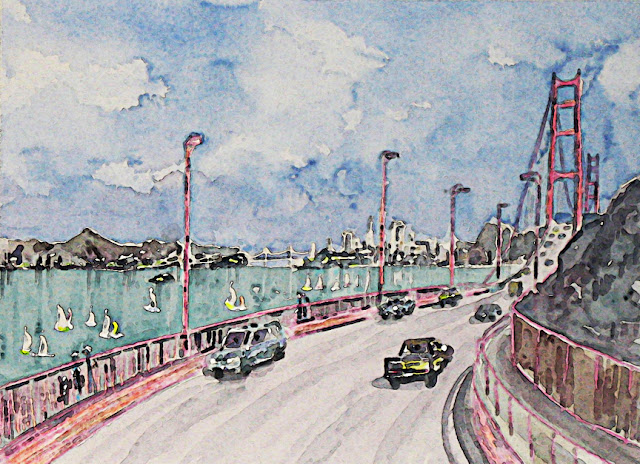
Golden Gate Bridge
Watercolour and crayon
©2010 Charlene Brown

When completed in 1937, the Golden Gate was the longest and tallest suspension bridge in the world.  It spans the mile-wide strait connecting San Francisco Bay to the Pacific Ocean.

Of the four examples highlighted in the 20th Century time capsule below, the Golden Gate Bridge, representing design in the Americas and Pacific, is the only one I’d already painted -- back in 2010 actually.  I'll be painting the other three over the next few weeks.


Sunday, January 23, 2022

The Last Nineteenth Century Painting


Chhatrapati Shivaji Maharaj Terminus
Watercolour and crayon
©2022 Charlene Brown

This historic Victorian Gothic Revival structure in Mumbai, India was originally named the Victoria Terminus, when completed in 1887, the 50th year of the reign of Queen Victoria, then the Empress of India. It was renamed in 1996 after Shivaji, the 17th century warrior king who employed guerrilla tactics to contest the declining Mughal Empire.

This UNESCO World Heritage site represents Asia in the time capsule shown in a blog post two weeks ago, Nineteenth Century Around the World. 


Sunday, January 16, 2022

The Nineteenth Century in Africa


Yoruba figure carvings
Watercolour and crayon
©2021 Charlene Brown

Instead of the usual landscape illustration, this painting is a diorama of typical 19th century Yoruba carvings.

The Yoruba, a large ethnic group found in parts of what are now Nigeria and Benin, created iconic art works in many mediums including wood carving.

The carvers generally used omo, iroko or mahogany.  The work was influenced by religious ritual, myths, regional perspectives, local history and, of course, the specifications of wealthy Nigerian patrons.  By the mid nineteenth century, the practice of slavery had created an African Diaspora through which Yoruba concepts and style were exported to the Western world.

Also, during the Colonial period, a new genre of carving developed in Africa, targeted to appeal to ex-patriates and visitors. For example, depictions of Queen Victoria, as in this diorama, sold well to Europeans as well as British ex-pats – especially at the time of the Queen’s Diamond Jubilee in 1897.


Sunday, January 9, 2022

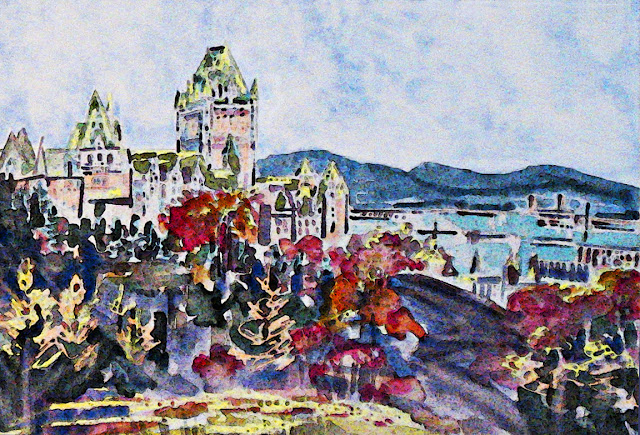
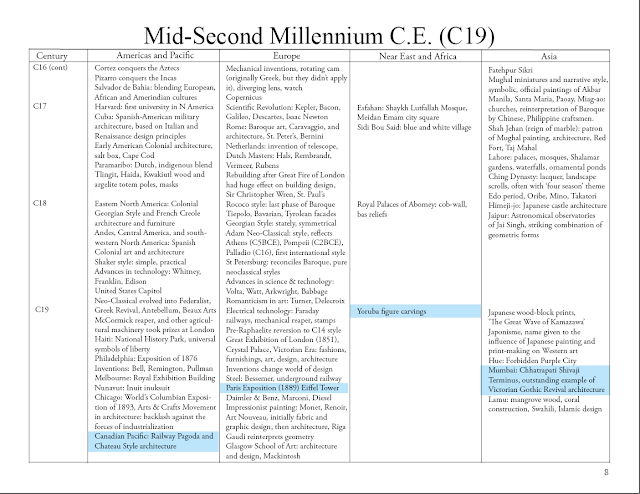
Nineteenth Century around the world


Château Frontenac
Watercolour and crayon
©2011 Charlene Brown

This magnificent example of the ‘chateau’ architecture built by the Canadian Pacific Railway opened in 1893.  It is situated perfectly on the citadel above Québec City.  This architectural style was meant to evoke the romanticism of the 14th and 15th century Châteaux of the Loire Valley.

Of the four examples highlighted in the 19th Century time capsule below, the Eiffel Tower representing design in Europe and this example of design in the Americas and Pacific are the only ones I’ve already painted.  I just painted the Eiffel Tower for last week's blog post, and this one was originally done in 2011, and eventually used in my book Inventing the Future.