Sunday, June 11, 2017

Here's what we did in Iran X

Towers of Silence
Watercolour, crayon and computer
©2017 Charlene Brown


Yazd was the birthplace, and remains a stronghold, of Zoroastrianism – the world’s first monotheistic faith. The day we arrived, we visited the Fire Temple, to which Zoroastrians from all over the world travel to see the sacred flame. As we departed for Isfahan the next day, we stopped at the Towers of Silence, where the dead were placed for ‘sky burial’ consumption by vultures.

Friday, June 9, 2017

Here’s what we did in Iran IX

Central square in Old Yazd, showing wind towers and the monumental Amir Chaqmaq complex


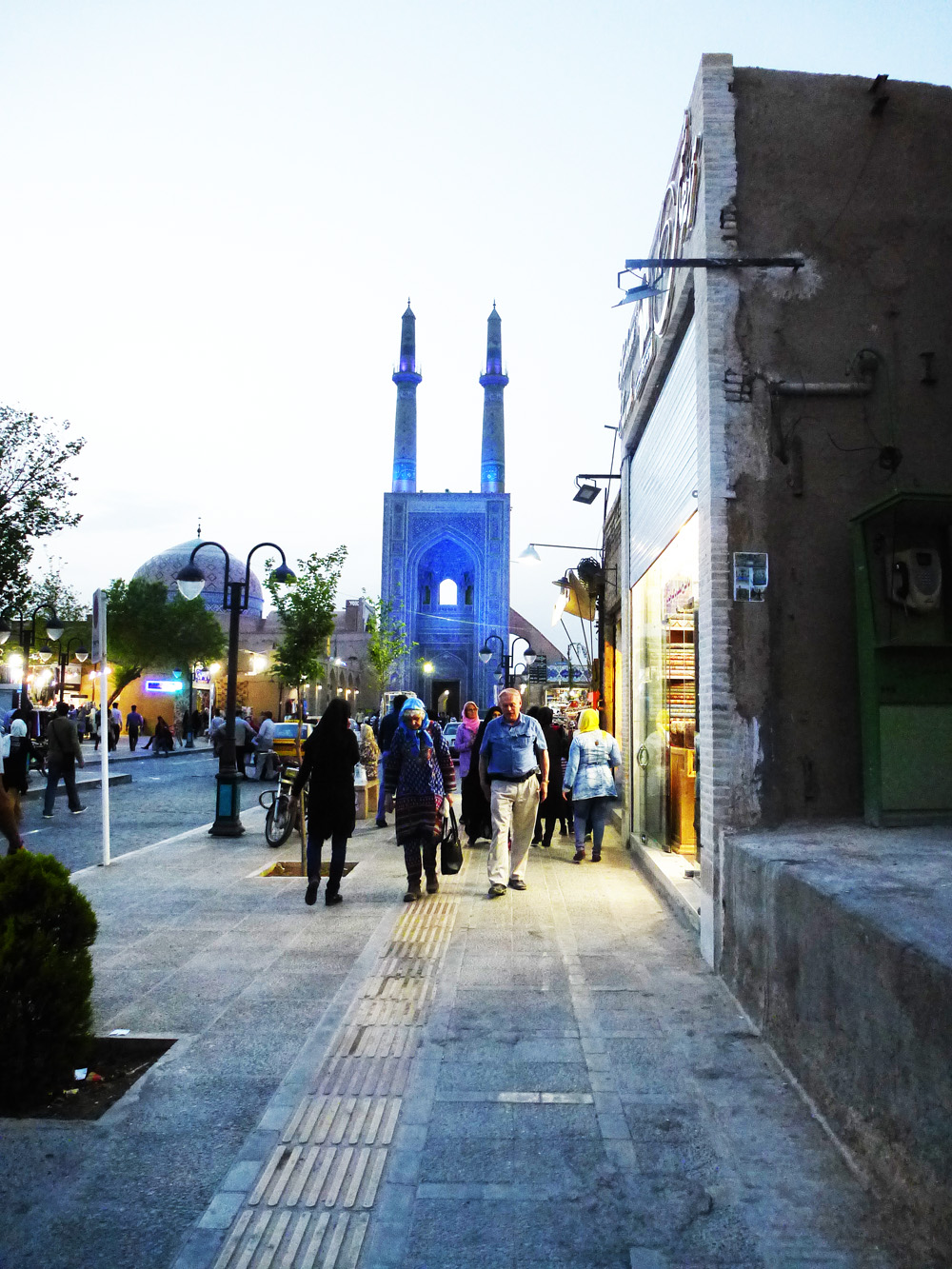
Our group from the Art Gallery of Greater Victoria, on the way to dinner in Old Yazd at sunset, Jameh Mosque in the background

Yazd, an oasis surrounded by the mountains of the high desert, is graced with great Islamic architecture.  But what I found most paintable were the many windtowers found in the narrow, shady streets of Old Yazd.

Yazd Iran


Neighbourhood mosque in Old Yazd
Watercolour, crayon and computer
©2017 Charlene Brown

According to Wikipedia, windtowers, or windcatchers, are traditional Persian architectural elements providing natural ventilation by catching the wind from any direction and directing it down into the building. Windcatchers can be found in traditional Persian-influenced architecture throughout the Middle East, including the Gulf Arab states, especially Dubai.  That is where I first saw them.

According to the World Bank, Dubai is one of the largest consumers of energy per capita in the world and in the summer months an estimated two thirds of that is used for air conditioning. There has been some hopeful theorizing that the windtower concept could be integrated into new buildings there and this might make a meaningful reduction in their “AC addiction.”

Wednesday, June 7, 2017

Here`s what we did in Iran VIII


The rock tomb of Darius the Great
Watercolour, crayon and computer
©2017 Charlene Brown

From Persepolis, our bus took us to Naqshe Rostam, about 10 km to the northwest. This precipitous cliff is one of the most spectacular and awe-inspiring sites of the ancient Achaemenid Empire, consisting of the colossal tombs of several Persian kings dating to the 4th and 5th centuries BCE as well as several reliefs carved by the Sasanians in the 3rd century CE. 

Friday, June 2, 2017

Here's what we did in Iran VII

Persepolis
Watercolour, crayon, computer
©2017 Charlene Brown

What I had expected to be the highlight of our trip – Persepolis, built by Darius the Great in 515 BCE and burned by the invading Greek army led by Alexander the Great not quite 200 years later – turned out to be everything I had hoped it would be, and more.  We explored the entire site – with a guide who continually referred to ‘Alexander the Not Great’ – from the statuary of the colonnaded gates to the long bas relief-lined stairways up to elevated terraces and palace ruins, and on up to the rock tombs from which the whole valley can be seen.

Here are some of my favourite sculptures.

Gate of All Nations
Bas relief in the Apadana Palace
Unfinished Gate

Wednesday, May 31, 2017

Here's what we did in Iran VI

Naranjestan Gardens
Watercolour, crayon and computer
©2017 Charlene Brown

The second part of our tour, in the southern, more frequently visited and hotter part of Iran, began with our arrival in Shiraz. We were scheduled to drive out to Persepolis the afternoon of the first day – by somebody who had never been there in the heat of the day, according to our guide.
She had arranged instead for us to go to Persepolis in the cool early morning of the next day, and took us to the Naranjestan Gardens and Nasir al Molk Mosque – both of which were pretty cool, even on a hot afternoon.


Mihrab at the Nasir al Molk Mosque

Sunday, May 28, 2017

Here's what we did in Iran V


Soltaniyeh Dome at Zanjan
Watercolour, crayon and computer
©2017 Charlene Brown


After exploring the many levels and barrel-vaulted passages of Takhte e Soleyman, we continued on our way to Qasvin, stopping to climb around the various levels of the ethereal blue interior of the massive Soltaniyeh Dome at Zanjan.

Interior undergoing renovation of all levels.  

This building, the oldest double-shell dome in the world, is a key monument in the history of Islamic architecture.

Wednesday, May 24, 2017

Here’s what we did in Iran IV

Takhte e Soleyman Iran

Takhte e Soleyman UNESCO World Heritage site
Watercolour, crayon and computer
©2017 Charlene Brown

After spending the night in Takab in a memorable ‘basic’ hotel, we proceeded higher into the Alborz Mountains to the spectacularly-located 1500-year-old Takhte e Soleyman fortress. The surrounding snow fields, which even included orchards beginning to blossom, made the place even more other-worldly than expected.

Sunday, May 21, 2017

Here's what we did in Iran III

Mehri Temple
Watercolour, crayon and computer
©2017 Charlene Brown

The second remote archaeological site we visited was the ­subterranean Mehri Temple in Maraqeh, recently re-discovered and at this point still being excavated. The sketch above is a combination of photos taken in three directions (think of it as a Cubist approach) showing Quranic inscriptions around the walls indicating that, although it was originally built in the 3rd century BCE by sun-worshippers, it was used as a mosque in the 13th century CE.


Finally we toured the ancient Sorkh Dome, built in the late 12th century CE, now being restored and set in a garden with Islamic designs and a huge vertical sun clock.