Saturday, December 19, 2015

Japan sketchbook - 3

Asakusa Temple
Watercolour, crayon and marker sketch
©2015 Charlene Brown


Next (and we are still talking about our first day here) was the magnificent Asakusa Temple as night fell... pure magic.  The original (Buddhist) temple, the oldest in Tokyo, was founded in 645 CE and a (Shinto) shrine was built within the precincts of the temple about a thousand years later. During World War II, the temple was bombed and destroyed, but was rebuilt later and is a symbol of rebirth and peace to the Japanese people. 

Friday, December 18, 2015

Japan sketchbook - 2

(click on image to enlarge)

Meiji Shrine
Watercolour and crayon sketch
©2015 Charlene Brown

After our serene little interval in the Imperial Garden we were deemed good to go and toured the National Museum and the Edo/Tokyo History Museum before a late lunch. 

In mid-afternoon we visited the very popular Meiji Shrine.  It’s a huge place, so the fact that this was National Culture Day, and it is customary for families to bring five-year-old boys and seven-year-old girls, beautifully dressed in National costumes, to the most significant historic sites in Japan on weekends or holidays in November, only added to the enchantment and there was plenty of space for all of us.


Thursday, December 17, 2015

Japan sketchbook - 1


Imperial East Garden in Tokyo
Watercolour, crayon and ink sketch
©2015 Charlene Brown

I’ve finally finished the ‘panorama format’ sketchbook paintings I started during our Art Gallery of Greater Victoria tour of Japan in early November. I'm scheduling them to be posted here between now and the end of the year – while we head south to meet our daughter and her family for Christmas in San Diego. (Yay!)

After what was for many of us the longest flight ever, our tour began with a leisurely stroll in the beautiful Imperial East Garden in the heart of Tokyo.  Initially I was taken aback by how green everything was, as I was looking forward to spectacular fall colours, but was assured by our guide that the season was much further along higher up in the mountains where we would be spending most of our time. 

I had brought along an array of orange and pink crayons, and did in fact find lots of applications for them, as you will see in a couple of days…

Wednesday, December 9, 2015

Virtual Paintout in Ecuador

(click on image to enlarge)
Christmas in Baños de Agua Santa
Watercolour and crayon
Charlene Brown

The Virtual Paintout is in Ecuador this month. This seemed to offer a good chance of finding mountainous terrain to paint and I first headed for the capital, Quito, situated high in the Andes at an elevation of 2850 meters. 

The city is usually within sight of the spectacular Cayanbe Volcano… but the only views of Quito I could find were pretty hazy, so I headed down to Baños de Agua Santa, sometimes known as the  Gateway to the Amazon, as it is the last city still located in the mountains before reaching the jungle of the Amazon basin. The atmosphere was lovely there, and I thought this Streetviewwith the Christmas tree in the centre, was just right for a December painting.


Friday, December 4, 2015

My favourite places in Japan

(Click on image to enlarge)
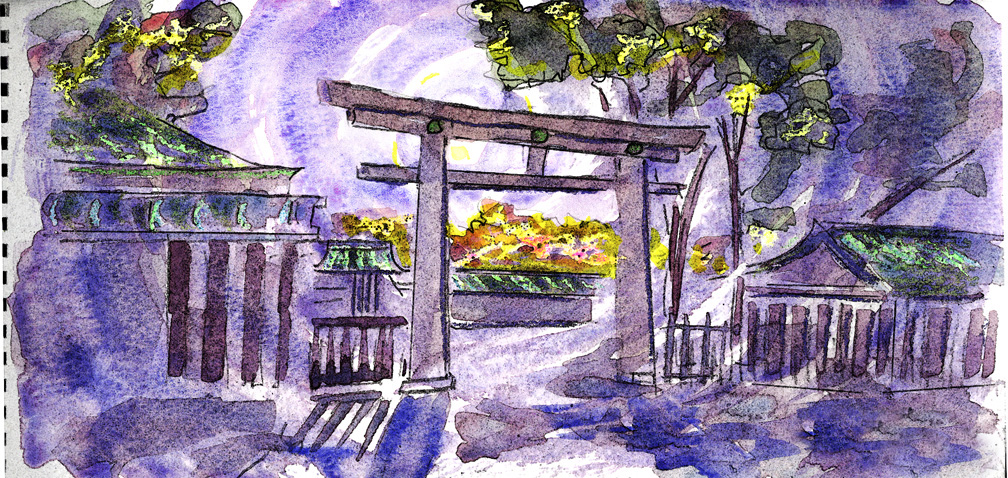
Nikko Gate
Watercolour and crayon
©2015 Charlene Brown


It’s the torii gate before you reach the main part of the Nikko shrine. Torii gates are found on the approach or entrance to all Shinto shrines, marking the transition from the physical to the spiritual world. They are usually either unpainted or painted vermillion – and I think I prefer the unpainted ones, like this one at Nikko.
   

Having said that, I found upon my return from Japan that I took more photos of the thousands of vermillion torii gates at the Fushimi Inari-taisha in Kyoto than just about any other place!  And one of the many sketches I started during my trip (and will paint some day soon) includes a couple of bright red torii gates in a village on Lake Ashi.

Friday, November 27, 2015

Virtual Paintout in Istanbul

(click on image to enlarge)
Firuz Ağa Mosque
Watercolour and crayon
Charlene Brown


After finding that good shots at the Blue Mosque and the Hagia Sophia are kind of hard to come by on Streetview (I even considered a `streetview` of the Blue Mosque from a ferry)  I had a look at the imposing Galata Tower on the Asian side of town, and almost tried this problematical streetview of it.   Then I just wandered until I happened upon this nicely composed view of the FiruzAğa Mosque as seen from the Mehmet Akif Ersoy Park


Sunday, November 22, 2015

Elegant Clean Energy Haiku VIII: Quantum Leap Haiku Illustration


Himeji Castle
t-shirt serigraph

This t-shirt I bought in Japan has a silk-screened design that is either the Japanese characters spelling out the words ‘Himeji Castle’ or a 17-shape haiga painting of the castle. Or both. I haven’t yet finished any of the paintings I started while I was in Japan, so I’ve added this design and the following quotations about haiku and haiga to the series of blog posts on Elegant Clean Energy Haiku I started on July 29 

“Both haiku and haiga translate nature through an artistic language with spiritual immediacy and selfless skill. This is achieved through Zen-like training in contemplation and technique. When the artist has reached the state of wu hsin (no-mind), a plane of mental relaxation and manual dexterity, Tao* can then take control and work through the artist’s hand and eye. This superconscious state is not to be confused with the subconscious swamp in which the surrealists find themselves.”  – On Haiku and Haiga: an essay, by Harold Stewart
 * Tao is a ‘path’ or process rather than a theory – a term used as a convention to refer to something that otherwise cannot be discussed in words.

“Haiku poet and haiga artist alike endeavored to eliminate every superfluous element and to attain an austere beauty, akin to that of abstract art...”  – Haiku Painting, by Leon Zolbrod

When the haiku writer and illustrator is a computer app, these essentially heuristic processes are going to have to be more algorithmic – well, totally algorithmic actually.  It should be possible to get around this apparent contradiction in terms through the provision for some manual input by the user.

Sunday, November 8, 2015

Clean Energy Haiku V: Quantum Leap Haiku Illustration – Plan B

South American Terraces I & II
Photoshop™
©2015 Charlene Brown


Remember the South American terrace paintings I mentioned in my September 2 blog post? 

In the pictures above they have been ‘abstracted’ by reducing the number and complexity of shapes in their composition. Reducing the complexity beyond the level of recognizability produces a non-representational design.

I hope to show that this design can evoke a quite different reality, especially when considered as a haiga, accompanied by a poem such as this enigmatic little computer-generated haiku:

Less is more for all
Superconductivity
Now accelerate

This is where the ‘quantum leap’ I defined at the end of my September 23 post comes in… How far do you need to go beyond ‘recognizable’ to make that leap?  Further than South American Terraces II, I suspect. 

Plan B will continue...