Sunday, January 30, 2022

Twentieth Century Around the World

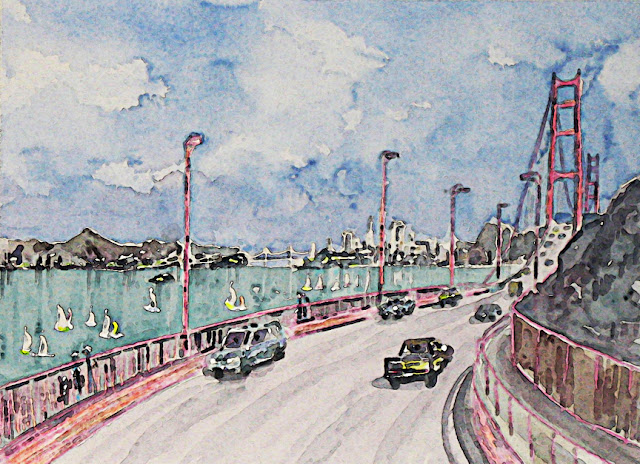
Golden Gate Bridge
Watercolour and crayon
©2010 Charlene Brown

When completed in 1937, the Golden Gate was the longest and tallest suspension bridge in the world.  It spans the mile-wide strait connecting San Francisco Bay to the Pacific Ocean.

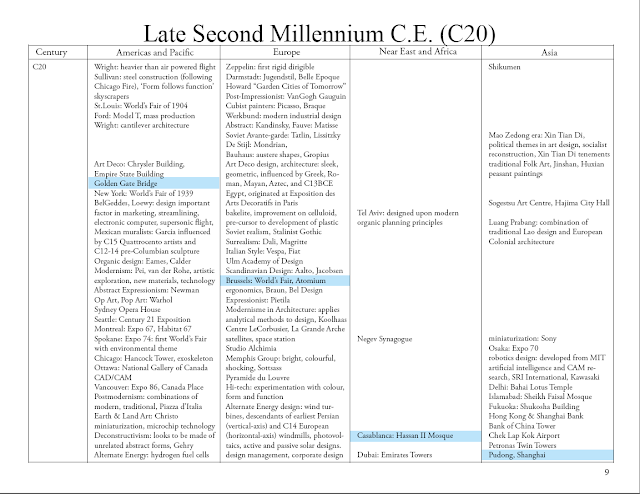
Of the four examples highlighted in the 20th Century time capsule below, the Golden Gate Bridge, representing design in the Americas and Pacific, is the only one I’d already painted -- back in 2010 actually.  I'll be painting the other three over the next few weeks.


Sunday, January 23, 2022

The Last Nineteenth Century Painting


Chhatrapati Shivaji Maharaj Terminus
Watercolour and crayon
©2022 Charlene Brown

This historic Victorian Gothic Revival structure in Mumbai, India was originally named the Victoria Terminus, when completed in 1887, the 50th year of the reign of Queen Victoria, then the Empress of India. It was renamed in 1996 after Shivaji, the 17th century warrior king who employed guerrilla tactics to contest the declining Mughal Empire.

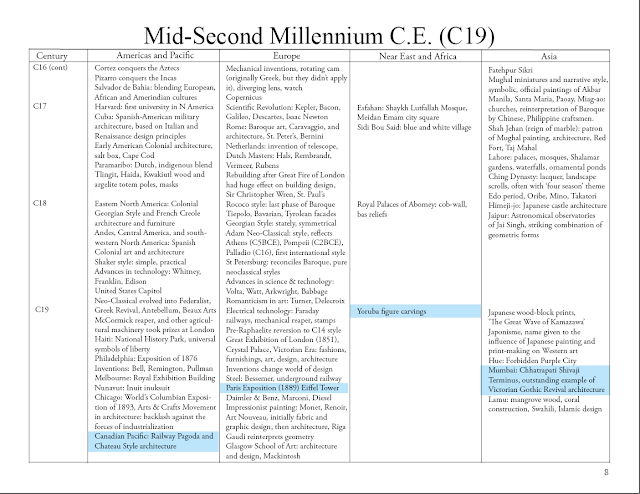
This UNESCO World Heritage site represents Asia in the time capsule shown in a blog post two weeks ago, Nineteenth Century Around the World. 


Sunday, January 16, 2022

The Nineteenth Century in Africa


Yoruba figure carvings
Watercolour and crayon
©2021 Charlene Brown

Instead of the usual landscape illustration, this painting is a diorama of typical 19th century Yoruba carvings.

The Yoruba, a large ethnic group found in parts of what are now Nigeria and Benin, created iconic art works in many mediums including wood carving.

The carvers generally used omo, iroko or mahogany.  The work was influenced by religious ritual, myths, regional perspectives, local history and, of course, the specifications of wealthy Nigerian patrons.  By the mid nineteenth century, the practice of slavery had created an African Diaspora through which Yoruba concepts and style were exported to the Western world.

Also, during the Colonial period, a new genre of carving developed in Africa, targeted to appeal to ex-patriates and visitors. For example, depictions of Queen Victoria, as in this diorama, sold well to Europeans as well as British ex-pats – especially at the time of the Queen’s Diamond Jubilee in 1897.


Sunday, January 9, 2022

Nineteenth Century around the world


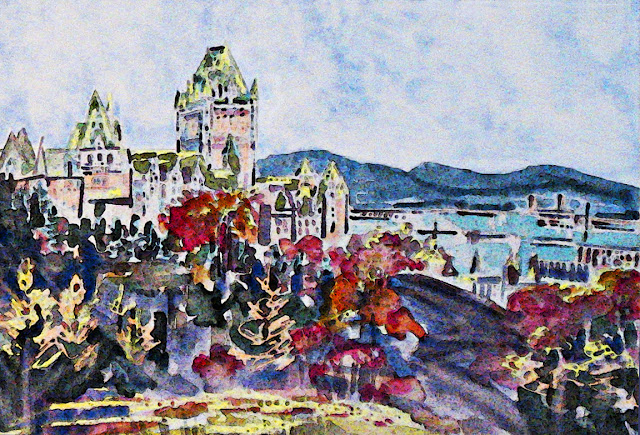
Château Frontenac
Watercolour and crayon
©2011 Charlene Brown

This magnificent example of the ‘chateau’ architecture built by the Canadian Pacific Railway opened in 1893.  It is situated perfectly on the citadel above Québec City.  This architectural style was meant to evoke the romanticism of the 14th and 15th century Châteaux of the Loire Valley.

Of the four examples highlighted in the 19th Century time capsule below, the Eiffel Tower representing design in Europe and this example of design in the Americas and Pacific are the only ones I’ve already painted.  I just painted the Eiffel Tower for last week's blog post, and this one was originally done in 2011, and eventually used in my book Inventing the Future. 


Sunday, January 2, 2022

My Plan for '1150 Words by Charlene Brown' in 2022


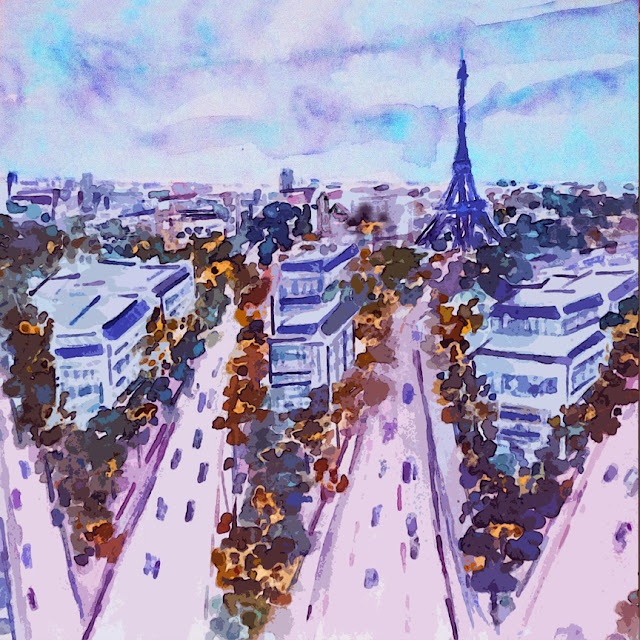
Eiffel Tower as seen from the top of the Arc de Triomphe
Watercolour and crayon
©2021 Charlene Brown

The Eiffel Tower was built to be one of the main attractions at the Exposition Universelle held in 1889 to mark the 100th Anniversary of the Fall of the Bastille and the launch of the French Revolution.  This painting will be one of the illustrations in the first project listed below.

History of Design:  A few years ago I put together a cross-cultural 'History of Design' timeline covering art and architecture from the third millennium BCE to the beginning of the twenty-first century. Since then I have illustrated the designs highlighted in this History of Design, and published them in stories such as this one about Design in the Second Millennium CE in the History section on the online platform Medium.  I plan to add The End of the Second Millennium CE (19th and  20th Centuries) to this series.

Graphic Novel:  As I mentioned last week, Canadians are kind of ‘electioned out’ so I won't be rushing to finish the graphic novel I’m working on – “By-election in Exceptional Pass” in 2022.  But I’ve got lots of background landscapes to work on, so I’m going to borrow this sentence from my Plan for (would you believe?) 2016, on which I didn’t make much progress –  “I hope to continue shifting from representational landscapes toward more stylized paintings and add some people to my landscapes” – and apply it to these backgrounds.

Creative Archaeology: And here’s a sentence from my Plan for 2021 – “In case my travel plans don’t work out any better than they did this year, I may re-interpret some of the photos and sketches I accumulated in past archaeology-related travel with the Art Gallery of Greater Victoria and University of Victoria travel study program” – on which I did make some progress, as I mentioned last week. I plan to continue the series ‘Time Travel with a Bag of Crayons’ working with the only truly portable plein air ‘painting’ kit I have discovered.


Sunday, December 26, 2021

How my 2021 plans for this blog worked out


 One of the places I might travel to with my daughters
Watercolour and Photoshop™

Travel painting: We’ll see how that goes – bound to be better than 2020, I declared at the beginning of this year.  To my surprise, my travel remained almost entirely virtual, or even bucket list, like the one above, and when I finally got out and painted a landscape, it was only 10 k from home.

Graphic novel: I wrote several blog posts about producing a graphic novel based on a screenplay, but only added six new paintings to the graphic novel I had started in 2020.  It is based on a by-election in a constituency in Alberta… and when the Canadian government called an unnecessary general election in September of this year, I realized there was little interest in elections of any sort, and put that project on hold.

Creative archaeology: In case my travel plans don’t work out, I planned to re-interpret some of the photos and sketches I accumulated in past archaeology-related travel with the University of Victoria travel study program.  I actually added 16 posts, throwing in re-worked paintings from Art Gallery of Greater Victoria trips as well.

Data analytics: I didn’t even mention this out loud in my plan for this year, but during 2021 I ended up following this ‘suggestion’ by the late Robert Genn: 

“There’s always something to get on with, actually one damn thing after another.”

One of the things that I ‘got on with’ was data analytics. In trying to convince some of my grandchildren that data analytics skills will be important for everybody, no matter what their field of study, it’s occurred to me it might be worthwhile to update my own understanding of the various concepts. There are four main kinds of analytics – descriptive, diagnostic, predictive and prescriptive.  I’m interested in predictive analytics, especially extrapolating and visualizing (and painting) unanticipated outcomes. I actually completed 14 blog posts that I tagged as ‘predictive analytics’ seven of which had original illustrations.  The other seven were re-posts of pages from my book, “Inventing the Future.” 

Next week I will post my Plan for 2022.
Sunday, December 19, 2021

A final favourite post from the past (August 2014)


The ascent of
the Mons Philosophorum
Watercolour and Photoshop™
©2014 Charlene Brown

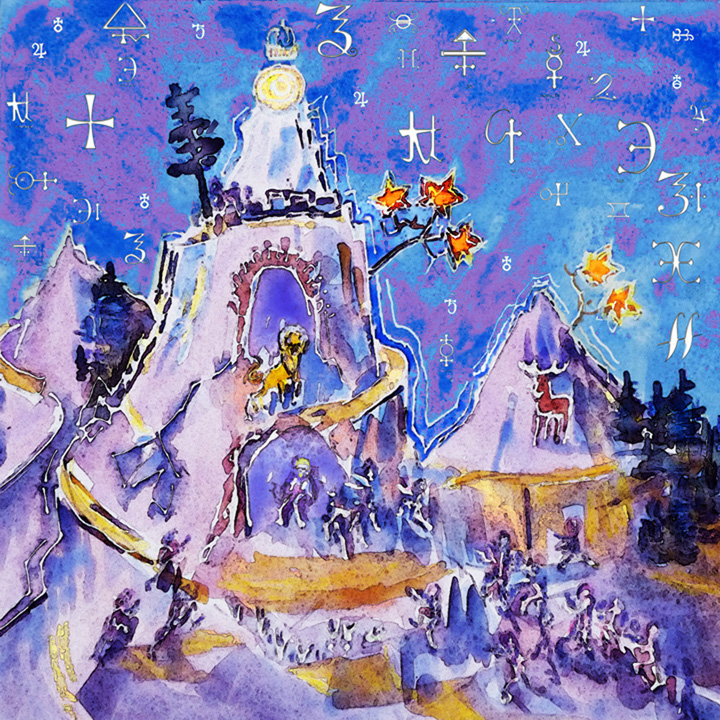
Alchemy was a medieval chemical science or speculative philosophy that aimed to achieve perfection. Its specific goals included the transformation of base metals into gold or at least silver, and the discovery of a universal cure for disease.

It evolved as an art - not as a science. Processes developed by alchemists never succeeded in producing gold or even silver, but they did produce building materials such as plaster and mortar, tar and asphalt, fuels for heat and light, artificial gems, medicines, soaps,  cosmetics, beer and wine. Many alchemical processes were discovered by accident, but once mastered, were passed on by an apprenticeship system.

The words ‘alchemy’ and ‘chemistry’ were used interchangeably during most of the 17th century. During the Enlightenment, however, a distinction was drawn because of the rise of modern science with its emphasis on rigorous quantitative experimentation and disdain for ancient wisdom… and the increasing disrepute of alchemists, who claimed through trickery, to achieve perfection – the ultimate goal of alchemy.

 Using Photoshop, I have added some popular alchemy symbols for metals, processes and measures – pounds, ounces and my personal favourite, the scruple.

Sunday, December 12, 2021

Another favourite post from the past (August 2020)

Heli-painting in the Bugaboos
Watercolour and crayon
©2020 Charlene Brown

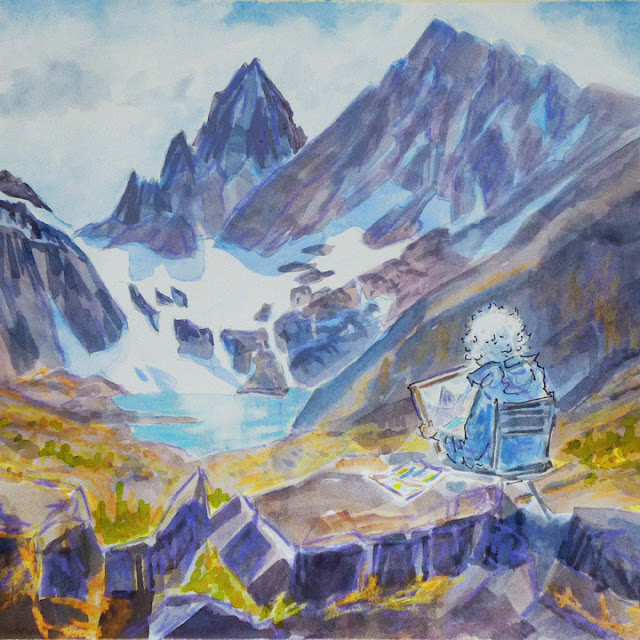
A call for online entries to an Artist & Selfie Painting Competition included an ‘Artists en Plein air’ category so I decided to enter a painting based on a photo of me taken on the heli-painting trip in 2012.

There was no requirement to mount, frame with glass covering, pack and ship the painting, and the entry fee was only USD 37. That ended up being CAD 50.78, which had risen to CAD 51.06 by the time it was posted on my Visa bill, but still… not having to ship the thing, usually a big problem with watercolours, was compelling.  And, there was no requirement to have your face appear in this portrait, also compelling.