Showing posts with label United States. Show all posts

Sunday, May 18, 2025

I used to live here


Wrangell-St. Elias Range from the Alaska Highway
crayon, watercolour and marker
©2025 Charlene Brown

Last week, I painted Pikes Peak near Colorado Springs to illustrate a blog post about a proposed energy transmission experiment, the Sun Train, running from a solar array at Pueblo, Colorado to Denver, about 170 kilometres to the north.  Colorado Springs is between the two.

This connection being rather tenuous, I didn’t include Pikes Peak when I added the Sun Train to a book of blog posts I’m compiling, ‘Visualizing the Anthropocene.’

We’ve lived in Colorado Springs for a couple of years (in fact our younger daughter was born there) and the painting gave me an idea for a series of blog posts illustrating places I used to live. 

Full disclosure – I only spent one summer working at a lodge on the Alaska Highway, and our particular stretch of highway was nowhere near as picturesque as the part shown here (which was about 60 miles away).  We were surrounded by muskeg and you couldn’t even see the mountains.  The only accurate part of the painting is the late summer fireweed, with the blooms at the very top of their 8-foot stems and puffy white seed capsules on the withered flowers lower down. That’s what the fireweed lining our stretch of the highway looked like when I left in September heading to Anchorage to fly over the pole to Europe and the next place I was to live (almost as briefly).  I’ll write about that next week.


Sunday, May 11, 2025

Experimental solution to electricity transmission problem


Pike's Peak and the Garden of the Gods
crayon and watercolour
©2025 Charlene Brown

In an Anthropocene article, Shipping Solar Power at the Speed of a Freight Train, Peter Fairley writes, “By charging up battery cars where renewable energy is cheap and delivering the power to where it’s needed, [a San Francisco start-up called The Sun Train hopes to show] railroads could break the clean energy transmission logjam.” They see freight cars packed with solar batteries transporting electricity obtained at a solar array near Pueblo, Colorado as the perfect way to by-pass the increasingly congested transmission grid in the Denver area.

The concept seems somewhat awkward, but if you consider other advantages like potential capacity increases and decreasing vulnerability of diversified transmission systems, they may have a practical solution.

Anyway, in looking for a way to illustrate this article so I could use it in a blog post, I came up with Pikes Peak, which is situated near Colorado Springs 70 km. north of Pueblo, about one third of the distance to Denver.


Sunday, March 16, 2025

Favourite Google Streetview ‘location’ paintings from 2011


 The Bank of Eureka & the Savings Bank of Humboldt, Eureka, California, USA

Via Verdi in Talana, Sardinia


St Louis Cathedral from Decatur Street, New Orleans, LA USA


Koyukuk River crossing, Alaska, USA

North of Glenorchy, Otago, New Zealand  
 

Ave. de Verdun, Eze, Alpes-Maritimes, France


Table Mountain from Leeukloof Drive, Cape Town, South Africa

Sunday, March 2, 2025

Favourite Google Streetview ‘location’ paintings from 2012


 Lomnický štít, Tatranska Lomnica, Slovakia

Water Street, St. Andrews-by-the-Sea, New Brunswick, Canada


Højbro Plads, Copenhagen, Denmark

Mahamakut Buddhist University, Chiang Mai, Thailand 


Breckenridge, Colorado, USA


Sunday, February 16, 2025

Favourite Google Streetviews from 2014


 Trädgårdsföreningen, Gothenburg, Sweden

Jinsha Township, Taiwan, ROC


Georges Pierhead, Liverpool, UK

Lake Jasna, Slovenia

Pershing Park, Washington, DC USA


Sunday, February 9, 2025

Favourite Google Streetview paintings from 2015

 Jones Bridge, Manilla, Philippines

Market Square, Tallinn, Estonia

View from the Castle Garden, Cesky Krumlov, Czech Republic

Sarqaq, Greenland


Nazimuddin Rd. Dhaka, Bangladesh 


Lemon Hill Dr., Philadelphia, Pennsylvania, USA
 

Sunday, February 2, 2025

Favourite Google Streetview ‘location’ paintings from 2016


 Scottish Parliament, Edinburgh, Scotland 

Bodhiraja Mawatha, Sri Lanka    

Napa Valley, California, USA  

 
Bleiksv, Norway                 

Wednesday, November 13, 2024

A proactive approach to four potentially awful years

Pangnirtung Fjord*
watercolour and crayon
©2007 Charlene Brown

Most of the articles in the Opinion section of the November 9 Globe & Mail were about ‘Trump Country.’  I read every word of disbelief/ disgust/dismay about the outcome of the American Election, and agreed with almost all of them.

But I have only clipped and saved one article, the relatively positive ‘Taking control of our relationship with Trump’ by Edward Greenspon, Janice Gross Stein, and Drew Fagan. 

The gist of this piece is that discussions with the Trump government must shift from “the most beautiful word in the world” – tariffs – to another subject of which he is fond negotiations.  And the focus should be on “doing things together in areas where we can clearly help them, and sometimes where only we can help.” These would include: Arctic security (hence the painting, above), critical minerals, energy security, and advanced technologies such as AI research, space surveillance, semi-conductor packaging.

*Pangnirtung is the only place in Canada where I’ve actually seen chartreuse arctic poppies. I like these flowers so much that I transplanted them as far away as Yukon in a painting I posted in 2016

Wednesday, October 16, 2024

Drawn and quartered in Seattle

Medieval stretching apparatus
Photoshopped™ photograph
©2024 Charlene Brown

On September 27, I flew to Seattle (23 minutes on Alaska Airlines), cleared U.S.Customs and proceeded to the Departures floor to check in for my flight to Madrid where I was to begin a two-week Art Gallery of Greater Victoria tour of Spain.  Here is what happened instead.

In the middle of the main concourse I turned slightly, but the thick treads on the running shoes I was wearing (because they were too big to pack) grabbed the polished floor and did not turn, even slightly.  And I did a face plant over the suitcase I was rolling. 

An agent from the nearby Delta desk cautioned me against trying to get up, called 911 and, most importantly, stayed with me (answering questions from the many people milling about) until the paramedics arrived.  An ambulance took me to St. Anne Hospital where it was determined by several x-rays and a CAT scan that I didn’t have a concussion but did have a fractured radius in my left arm.  

An ER doctor warned that for their next trick they would be using the Medieval torture apparatus pictured on the left.  Soon I was strung up to five chain mail cylinders which grabbed and held the fingers of my left hand, stretching my suspended (and weighted) arm while the parts of the radius were prodded back in line.  The pain was nowhere near what I was expectng after that grizzly introduction. Apparently their bone-setting expertise includes highly skilled management of expectations.

The next day Alaska Airlines accepted my return ticket to Victoria (dated today, Octoner 16), and put me on the first available flight home.  


Sunday, August 11, 2024

Sketching an Alaska Cruise VIII


Klawock AK
crayon, ink and watercolour
©2024 Charlene Brown

Klawock, with a population of about 800, is situated on Prince of Wales Island. This is their first year in the cruise ship business, and unlike Ketchikan, less than 90 kilometres away, they are working hard to increase the number of ships visiting there.  (Ketchikan, along with Juneau and Skagway, are looking at restricting the number of cruise ships and some residents are even hoping that occasional cruise-free days can be scheduled!)

As we filed onto Klawock’s brand new docking facility from the Regatta (their third cruise ship ever), we were treated to a Tlingit welcoming ceremony with singing and dancing and refreshments followed by a free shuttle to a unique arts and crafts exhibition and totem carving centre.  The beautiful native work we were shown was probably the most authentic that we saw anywhere in Alaska.    

Sunday, August 4, 2024

Sketching an Alaska Cruise VII


Cruise ship terminal, Sitka AK
crayon, ink and watercolour
©2024 Charlene Brown

Russian explorers settled Old Sitka in 1799, naming it Fort of Archangel Michael.  In June 1802, Tlingit warriors destroyed the original settlement, killing many of the Russians. The Russians got it back following the Battle of Sitka in October 1804, and established the rebuilt town as New Archangel which they designated the capital of Russian America.

The original Cathedral of Saint Michael the Archangel was built in Sitka in 1848 and became the seat of the Russian Orthodox bishop of Kamchatka, Alaska, and the Kurile and Aleutian Islands. 

Full disclosure: This cathedral (shown in the painting above) is located in the downtown business district of Sitka, nowhere near the cruise ship terminal.

Russia was going through economic and political turmoil after it lost the Crimean War to Britain, France, and the Ottoman Empire in 1856, and decided it wanted to sell Alaska before British Canadians tried to conquer the territory. Sitka was the site of the transfer ceremony for the Alaska purchase by the United States on October 18, 1867. The purchase price (at 2 cents per acre) was $7.2 million.

Sunday, July 28, 2024

Sketching an Alaska Cruise VI


Icy Strait Point from the Skyglider Gondola
crayon, ink and watercolour
©2024 Charlene Brown

In 2001 the Huna Totem Corporation began development of America’s only private cruise ship destination and in 2004, it welcomed its first ship. Icy Strait Point grew steadily each year except for the pandemic years 2020 and 2021, thriving as a cruise port that preserves the character of the local village and Tlingit culture as much as possible.

The Skyglider Gondola took us from Wilderness Landing to the top of the mountain and offers stunning views north over the water toward Glacier Bay National Park. At the top of the mountain there are nature trails through unique wildlife habitat with spectacular views in all directions.

The painting above includes the two huge cruise ships in port at the time we were there, and our smaller ship, Regatta. from which we needed to tender ashore.  Tendering, in the ship’s lifeboats – which were nowhere near as luxurious as the ship itself was required quite frequently on this cruise because the number of cruise ships plying South-east Alaska often exceeds the docking facilities available. I’ll write more about that in my blog post about Klawock in two weeks.

Map showing the northernmost portion of our cruise


Sunday, July 21, 2024

Sketching an Alaska Cruise V


Hubbard Glacier
crayon and watercolour
©2024 Charlene Brown

This was the first of four places I had not seen on previous Alaska cruises in 2001 and 2005.

The Hubbard Glacier is North America's largest tidewater glacier. It flows 120 kilometres from Kluane National Park in the Yukon Territory of Canada through Wrangell-St. Elias National Park in Alaska.  It is 11 kilometres wide and over 100 metres above the waterline at its terminal face.

Allegedly, you can see Mt. Logan, the highest mountain in Canada, from our ship’s position in Disenchantment Bay.  However, most of the time we were there it was raining so hard you could barely see the face of the glacier, and the mountains above it were even less visible. 

Sunday, July 14, 2024

Sketching an Alaska Cruise IV


A picturesque glimpse into Skagway’s colourful past
crayon, ink and watercolour
©2024 Charlene Brown

When we returned from our drive up the Klondike Highway to Fraser BC, we stopped at the north end of Skagway.  There, a short hike up through the Gold Rush Cemetery brought us to a lovely little waterfall, Lower Reid Falls.

The waterfall is named after Frank H. Reid, the ‘good guy’ (by most accounts), in an historic gunfight in 1898. He shot the other participant, or ‘bad guy,’ a con man named Jefferson Randolf (Soapy) Smith, in “self-defence,” in the back (see what I’m doing here?)  Reid’s grave has an elaborate headstone, but Smith’s (just outside of the perimeter of the cemetery) tersely states his name, date of death and age, not even hinting at his side of the gunfight story.

Many of the graves are surrounded by intricately-carved fencing and sport colourful stories about the occupants’ advertised and actual occupations and circumstances of death.

Sunday, July 7, 2024

Sketching an Alaska Cruise III


Captain William Moore Bridge
crayon, ink and watercolour
©2024 Charlene Brown

This asymmetric single-pylon cable-stayed bridge is an impressive example of earthquake engineering. It spans the Moore Creek Gorge which flows along an active seismic fault line on the Klondike Highway about 27 km north of Skagway. To minimize potential bridge damage from earthquake movements along the fault line, the bridge was cantilevered, with anchors only at the south end.

Before the bridge was built in 1976, Whitehorse YT was only accessible from Skagway by the White Pass and Yukon Route railroad. Over the decades, heavy ore truck traffic weakened the bridge, and in 2019 it was replaced. The 1976 cable-stayed bridge was repurposed as a pedestrian viewpoint and historic site.

The view of the bridge shown in the painting above was based on photos taken when we stopped about a kilometre past it to look back at the highway.                                   

Friday, July 5, 2024

2024 Mid-Year Review

Skagway AK
crayon, watercolour and ink
©2019 Charlene Brown

I have been to Skagway twice before and have painted State St. several times, most recently in 2019. It looked much the same, with two cruise ships docked at the end of the main street on this year’s cruise.

I’ll continue ‘Sketching an Alaska Cruise’ this Sunday.  For today, here’s a quick mid-year review (yes, the year is in fact half over!) of how I’m coming along with my plans for 1150 Words, as set out at the beginning of this year

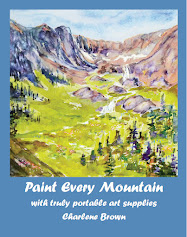
Paint Every Mountain: I finished and published this book about hiking and painting in mountains all over the world.

Creative Archaeology:  I have continued to build the series ‘Time Travel with a Bag of Crayons’ equipped with the same plein air painting kit I used for ‘Paint Every Mountain.’  The series, now in chronological order, will include some of the photos and sketches I accumulated in past archaeology-related travel with the Art Gallery of Greater Victoria and the travel study program at the University of Victoria.

Predictive Analytics This has evolved into a series of essays and illustrations of the increasingly drastic climate effects of the Anthropocene.

Sunday, June 30, 2024

Sketching an Alaska Cruise II


Mendenhall Glacier
crayon and watercolour
©2024 Charlene Brown

Our second port of call was Juneau, and a shore excursion to the Mendenhall Glacier. 

I was much more successful in “quickly capturing the essence” of this landscape, thanks to the Mendenhall Glacier Visitor Center provided by the US Forest Service. 

The sheltered, perfectly located presentation area took in the entire glacier and even included the top of spectacular Nugget Falls to the right of the glacier toe.  (I altered the perspective slightly to reflect the viewing angle from the upper part of the Visitor Center but, unlike my Ketchikan composition, only one viewpoint was required to see all the components of Mendenhall Glacier.)

The presentation area even included a long lectern-like table to hold notepads and sketchbooks!


Sunday, June 23, 2024

Sketching an Alaska Cruise


Ketchikan
crayon, ink and watercolour
©2024 Charlene Brown

In my book, ‘Paint Every Mountain’ I include some tips on quickly capturing the essence of a landscape with a few colourful ‘shapes’ using an easily carried painting kit ─ a bag of crayons. 

I don’t always follow these ‘essence’ tips, myself especially when I encounter a landscape with as many intriguing details and peculiarities as we found in Ketchikan AK, the first port of call on our recent cruise. 

Only partly cloudy the day we were there, Ketchikan is normally so wet that its annual rainfall is recorded in feet (about 13 of them)! The main street through town is set on pillars in the sea at the base of the lush mountainside. Side streets are so steep some are not ‘streets’ at all, but wooden staircases snaking up the rain-forested slopes. And Creek Street is in fact a creek, with moss-covered bridges and houses, artists’ studios and shops cantilevered over the torrent. 

Sunday, December 31, 2023

2023 Year-end Review


Maroon Bells*
watercolour, crayon and Photoshop™
©2023 Charlene Brown

In my August 27blog post, after exactly a year of not writing anything on my blog, I wrote, “At this point I’m going to pick up where I left off on the unfinished projects in my 'Plan for 1150 Words in 2022' as if it had been written in January 2023.”

Here’s how that worked out:

Graphic Novel:  I have stylized some of my representational landscapes to use as backgrounds for the book’s illustrations, added people and conversation ‘balloons’ to these stylized backgrounds, and published ‘By-election in Exceptional Pass’ in mid-November.

Paint Every Mountain: I have almost finished a small book about hiking and painting in mountains all over the world, working with what I have found to be the only truly portable plein air ‘painting’ kit, a bag of crayons. The above painting of Maroon Bells will be included in the section of the book on specific colours.

Creative Archaeology:  I have continued to build the series ‘Time Travel with a Bag of Crayons’ equipped with the same plein air painting kit I used for ‘Paint Every Mountain.’  The series, now in chronological order, will include some of the photos and sketches I produced during past archaeology-related travel with the Art Gallery of Greater Victoria and the University of Victoria travel study program.

Predictive Analytics: I have painted several illustrations of the climate effects of the Anthropocene.  Some are straight-up landscapes and others are interpretations/extrapolations of data relating to Greenhouse Gas (GHG) emissions.

*Maroon Bells: According to the U.S. Forest Service, these Colorado mountains received their distinctive maroon coloring from the weathering of hematite. I don’t recall that they were particularly maroon-looking.  In fact they were kind of liver-coloured until I applied some mauve crayon.

Sunday, June 12, 2022

Painting a Misty Memory


Na Pali Coast, Kauai, USA
Watercolour and crayon
©2022 Charlene Brown

I wrote several blog posts about the trips on which I took each of my grandchildren, back in the day.  Hawaii was our destination in 2005, and I wrote blog posts about that trip on Dec. 4, Dec. 14Dec. 18and Dec.23, 2016.

I started publishing stories about ‘My Travels With Our Grandkids’ online on Medium, beginning this March with my 2004 trip to Costa Rica. For that story I used the same photos and paintings I’d used on this blog. 

For the Hawaiian trip, however, I wanted to add a picture of the spectacular Na Pali coast on the island of Kauai. I hadn’t included any of my photos of it in the blog posts because they were very misty and totally unrecognizable to anyone but me  So I painted this picture showing details I had recorded only in my (not particularly photographic) memory.